
Portfolios run at the level of risk you choose
Alder Row Investment Management (sample) runs investment portfolios for private clients, families and charities in Springfield. We agree a risk level with you, from 1 to 7, and keep your portfolio there.
Our portfolios on the seven-level risk scale (sample)
Levels 1 to 7
No portfolio at this level
None
We do not run a portfolio at level 7. Single-country and single-sector funds usually sit here.
Lower risk, usually lower returns
Higher risk, usually higher returns
Shares Bonds Cash Figures: shares / bonds / cash, in percent (sample).
The value of investments can fall as well as rise, and you may get back less than you put in.
Who we work for
Most clients have between $100,000 and $3 million to invest (sample), and want one person who knows their portfolio and answers the phone.
Private investors
Savings from a business sale, an inheritance or years of putting money aside, invested for the long term.
Saving for and living in retirement
Building a pension pot, then drawing an income from it without running it down too fast.
Families and trusts
Money held for children or grandchildren, with trustees who need clear reports.
Charities
Reserves and endowments run to a written investment policy agreed with the trustees.
How we set your risk level
Before we invest anything, we agree where your money should sit on the scale. Four steps, and the last one repeats every year.
A questionnaire
Twelve questions about how you feel when markets fall. It takes about fifteen minutes and gives a score.
Your capacity for loss
We look at your income, other savings and when you will need the money: how big a fall you could live with, not only how you would feel.
A level we agree
We explain where both answers point on the scale from 1 to 7, and you choose the level. It is written into your agreement.
A review every year
Lives change. Each year we ask the questions again and move the portfolio to a new level only if you agree.
The questionnaire is the same for every client (sample).
What is inside a portfolio
Every portfolio is built from the same three parts. The level on the scale decides how much of each it holds; rebalancing keeps it there.
Shares
Part-ownership of companies, through funds that hold hundreds of them. Shares move the most, up and down, and are the main reason a portfolio sits higher on the scale.
Bonds
Loans to governments and large companies that pay interest. They usually move less than shares and often steady a portfolio when shares fall, though not always.
Cash
Deposits and very short-dated bonds, kept for withdrawals and fees so we never have to sell at a bad moment to pay them.
Rebalancing
Markets pull a mix away from its level. Twice a year we sell a little of what has grown and buy what has fallen behind, so the portfolio stays where you agreed.
Fees, in plain figures
One annual fee, a percentage of what we look after, taken monthly from the portfolio. The rate falls as the portfolio grows.
First $500,000
0.90% a year
Next $500,000
0.70% a year
Above $1 million
0.50% a year
Fund costs (average)
Charged inside the funds we buy; shown on every statement
0.20% a year
Joining or leaving
No charge
Example prices. Minimum portfolio $100,000; ready-made portfolios from $25,000 (sample).
What the fee includes
- Your own portfolio manager and a direct phone line
- Running and rebalancing the portfolio
- Quarterly statements and an online valuation
- A review meeting every year
- Tax reports for your accountant each spring
On a $400,000 portfolio the fee is $3,600 a year, plus about $800 of fund costs (example).

What you see, and how often
No guessing about where your money is. You can check the portfolio any day, and we write to you every quarter.
- A statement every quarter: holdings, mix, fees and every trade
- An online valuation, updated each working day
- A review meeting once a year, or sooner if you ask
- A tax report each spring for your accountant
The people who run your portfolio
A small team, so you always speak to someone who knows your portfolio. Every client has a named portfolio manager.
Helen Marsh
Chief investment officer (sample)
Chairs the investment committee and looks after charity clients.
David Okoye
Portfolio manager (sample)
Private clients and families; runs the Balanced and Growth portfolios.
Priya Natarajan
Portfolio manager (sample)
Retirement clients and the Cautious and Defensive portfolios.
Tom Lindgren
Client services (sample)
Statements, transfers, paperwork and the first call when you ring.
Names and roles (sample).
Market notes
-
What the risk number on a fund document tells you
- Details
- October 11, 2026

Seven boxes, one shaded: how the number is worked out and what it leaves out (sample note).
-
Rebalancing: why a portfolio sells some of what went up
- Details
- October 6, 2026

Twice a year we bring every portfolio back to its mix. Here is why (sample note).
-
Shares, bonds and cash: what each part of a portfolio is for
- Details
- October 1, 2026

Three building blocks, three different jobs (sample note).
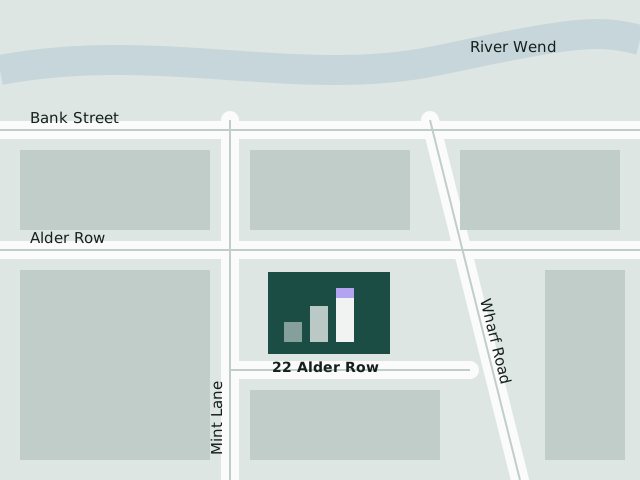
Visit the office
22 Alder Row, second floor
Springfield (sample)
Monday to Thursday
09:00–17:30
Friday
09:00–16:00
Evening meetings
By appointment
Opening times (sample). Step-free entrance and a lift to the second floor.