Observing nights
Club nights at the field and on the roof terrace, planned by the Moon. Two months at a glance, then what happens on each kind of night.
The next two months
Each night drawn with the Moon as it will be that evening. Ringed nights are club nights.
November 2026 (sample)
Sun
Mon
Tue
Wed
Thu
Fri
Sat
Sun 1, last quarter1
Mon 2, last quarter2
Tue 3, last quarter3
Wed 4, waning crescent4
Thu 5, waning crescent, Club talk5
Club talk
Fri 6, waning crescent6
Sat 7, waning crescent, Dark-sky night7
Dark-sky night
Sun 8, new moon8
Mon 9, new moon9
Tue 10, new moon10
Wed 11, waxing crescent11
Thu 12, waxing crescent12
Fri 13, waxing crescent, Dark-sky night13
Dark-sky night
Sat 14, waxing crescent14
Sun 15, first quarter15
Mon 16, first quarter16
Tue 17, first quarter, Moon night17
Moon night
Wed 18, first quarter18
Thu 19, waxing gibbous19
Fri 20, waxing gibbous20
Sat 21, waxing gibbous21
Sun 22, full moon22
Mon 23, full moon23
Tue 24, full moon24
Wed 25, full moon25
Thu 26, waning gibbous26
Fri 27, waning gibbous, Planet night27
Planet night
Sat 28, waning gibbous28
Sun 29, waning gibbous29
Mon 30, last quarter30
December 2026 (sample)
Sun
Mon
Tue
Wed
Thu
Fri
Sat
Tue 1, last quarter1
Wed 2, last quarter2
Thu 3, last quarter, Club talk3
Club talk
Fri 4, waning crescent4
Sat 5, waning crescent, Dark-sky night5
Dark-sky night
Sun 6, waning crescent6
Mon 7, new moon7
Tue 8, new moon8
Wed 9, new moon9
Thu 10, new moon10
Fri 11, waxing crescent, Dark-sky night11
Dark-sky night
Sat 12, waxing crescent12
Sun 13, waxing crescent, Meteor watch13
Meteor watch
Mon 14, waxing crescent14
Tue 15, first quarter15
Wed 16, first quarter16
Thu 17, first quarter, Moon night17
Moon night
Fri 18, waxing gibbous18
Sat 19, waxing gibbous19
Sun 20, waxing gibbous20
Mon 21, waxing gibbous21
Tue 22, full moon22
Wed 23, full moon23
Thu 24, full moon24
Fri 25, full moon25
Sat 26, waning gibbous26
Sun 27, waning gibbous27
Mon 28, waning gibbous28
Tue 29, last quarter29
Wed 30, last quarter30
Thu 31, last quarter31
Ringed nights are club nights (sample): dark-sky nights on Sat 7 and Fri 13 at Cutler Ridge, the moon night on Tue 17 and a planet night on Fri 27 on the roof terrace, the club talk on Thu 5 in the dome. Dome shows run every Friday to Sunday, cloud or clear. Dark-sky nights on Sat 5 and Fri 11, the Geminid meteor watch on Sun 13, the moon night on Thu 17 (sample).
Three kinds of club night, set by the Moon
Moonlight washes out faint galaxies but shows craters at their best, so the Moon decides which night is which. Each kind of night is drawn with the Moon that sets it.
The Moon at new moon
The weekend nights nearest new moon, when the sky is darkest: galaxies, nebulae and the Milky Way through the big telescopes at the field.
Where
Cutler Ridge field, 22 km north
When
From 30 minutes after sunset
Who
Members and their guests
The Moon at first quarter
At first quarter the Moon is up in the evening and the craters stand out along the shadow line. Telescopes on the roof terrace, open to everyone.
Where
Roof terrace of the planetarium
When
19:00-21:30
Who
Everyone, free
The Moon at full moon
Planets are bright enough to see in moonlight and from town, so planet nights can fall on any phase. This season: Saturn, then Jupiter.
Where
Roof terrace of the planetarium
When
When a planet is well up after dark
Who
Everyone, free
If it is cloudy at 17:00 on the day, the night moves to the next date on the calendar (sample). Check the top of this page or call the desk.
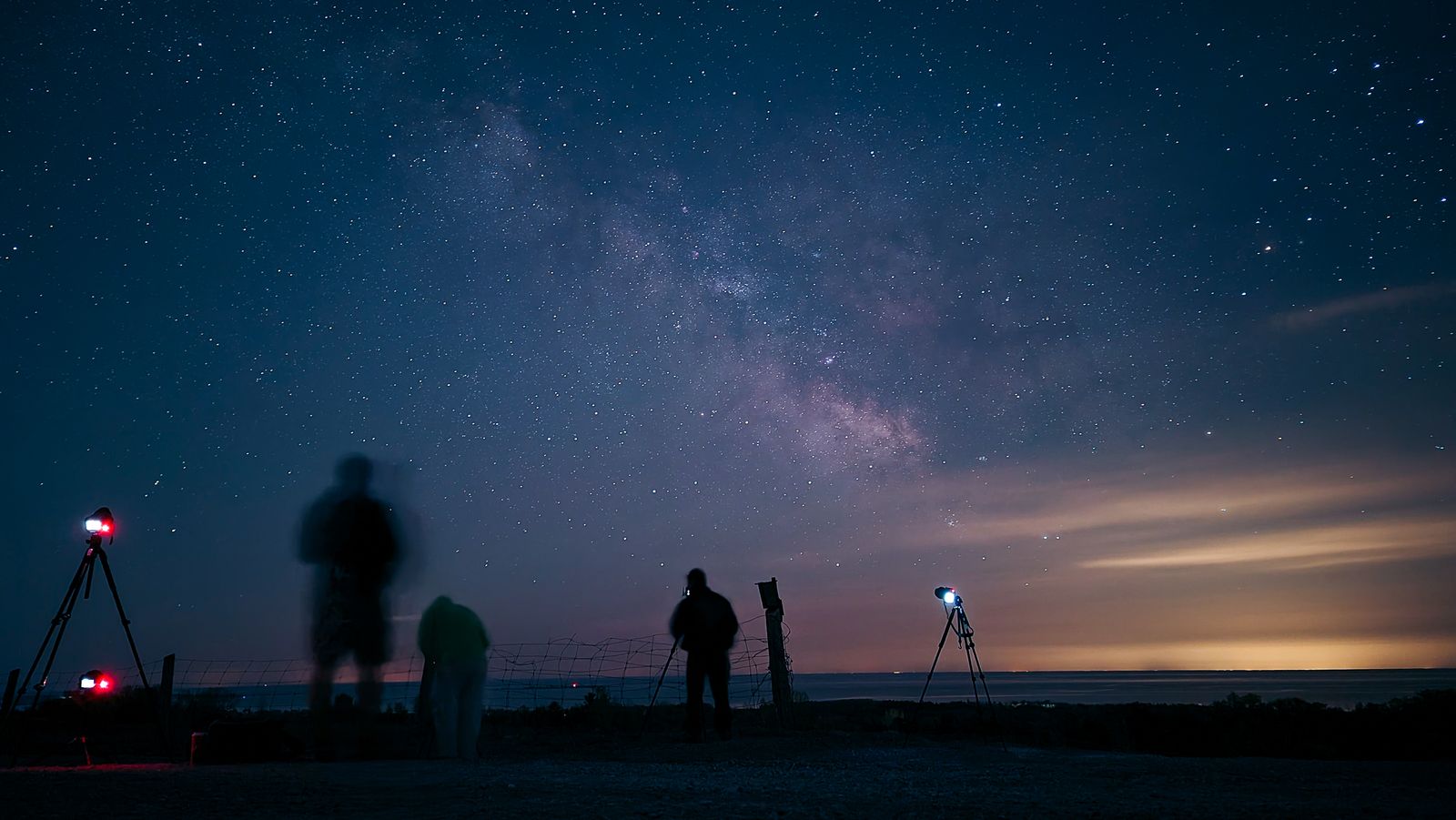
The dark-sky field at Cutler Ridge
A fenced meadow on a ridge north of town, far from street lights, with concrete pads for the club telescopes and a warm hut for coffee between looks.
Distance
About 25 minutes by car from the planetarium
22 km
Sky darkness
Rural sky: the Milky Way casts faint shadows
Bortle 3
Telescopes on site
From a 6-inch refractor to a 16-inch reflector
4
Parking
Park facing away from the field, lights off
15 cars
Field facts (sample).
Your first club night
The questions people ask on the phone before they come out for the first time.
Do I need my own telescope?
No. The club brings its telescopes and a member stays at each one. If you have binoculars, bring them: they show more than most people expect.
What if it is cloudy?
We decide at 17:00 on the day and post it at the top of the website. A cancelled night moves to the next date on the calendar. Dome shows run whatever the weather.
How cold does it get?
Colder than you think, because you stand still for hours. Wear a hat, gloves and one more layer than feels sensible. The hut at the field is heated.
Why only red torches?
Your eyes take about 20 minutes to get used to the dark, and one white light undoes it. Red light does not. We lend red torches at the gate.
Can children come?
Yes, with an adult. Moon nights on the roof terrace are best for children: short waits, a bright target and home by bedtime.
Come out on a club night
Club nights are free for members and open to anyone on moon and planet nights. Bring warm clothes; we bring the telescopes.